
An inclusive space does not emerge simply because there is a “kind atmosphere.”
In the practices observed here, safety and reassurance were built through concrete forms of design: methods of check-in, the language used, one-to-one relationships, and the explicit recognition of boundaries.
These were not accommodations positioned outside the creative process. They formed the foundation that made collaboration and expression possible.pression possible.
Making the Expression of Need Nothing Special
At BLINK, people begin by using an “I Need” board to share how they are feeling that day and what support they may need.
This practice is used not only in rehearsals, but also in meetings and everyday office work.
What is significant is that expressing one’s needs is not treated as a special request.
It is understood as a normal and essential part of working together.
The aim is not simply to help those who are struggling.
Rather, it starts from the recognition that everyone arrives with different circumstances, energies, and needs on any given day.
The expectation that anyone can communicate those needs is built into the space from the outset.
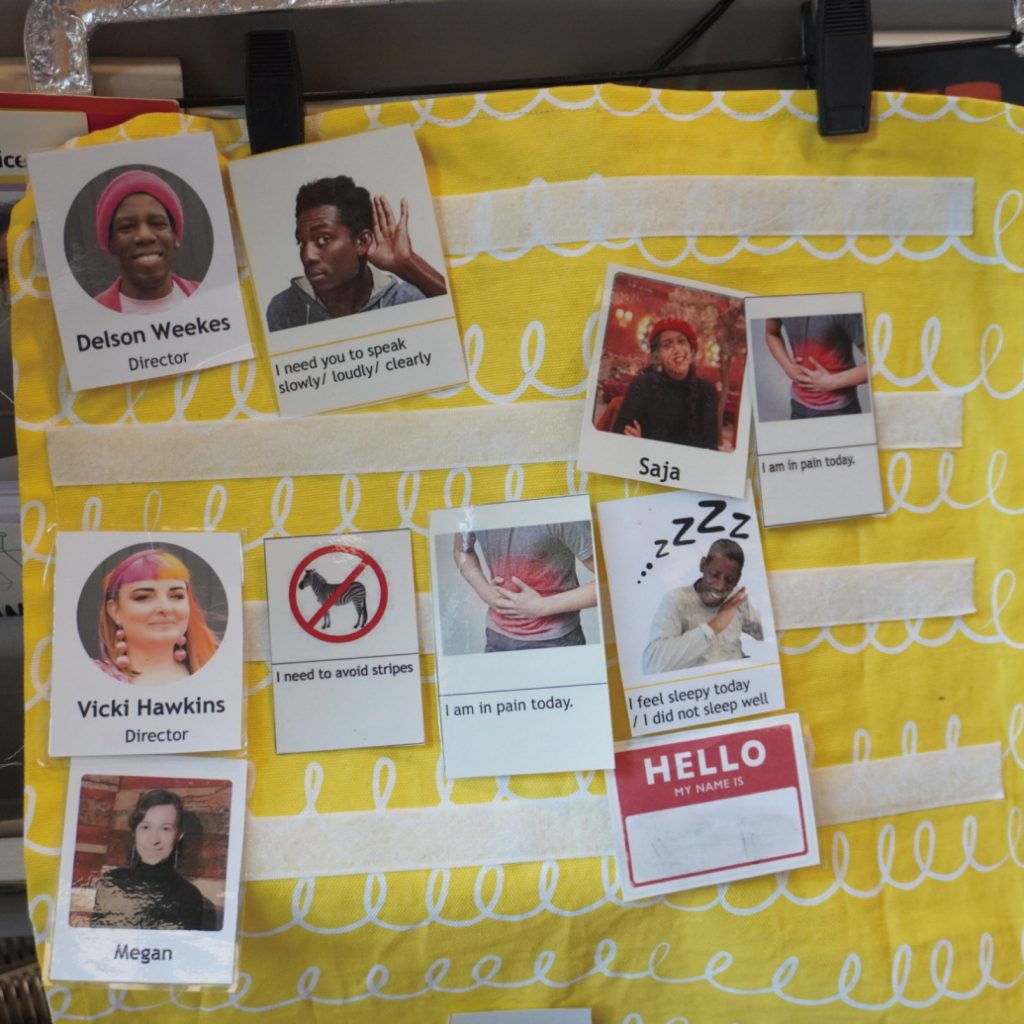
“Every time we come into the BLINK space, we do the I Need board. Whether we’re doing office work, rehearsals, meetings, or board meetings, we always do I Need.”
— Vicki Hawkins, BLINK Dance Theatre
Understanding Is Not an Individual Effort, but the Responsibility of the Space
At BLINK, communication was not limited to using plain English. When needed, dance, drawing, and objects were also used as ways of conveying meaning.
It was also striking that in several organizations, communication tools such as signs and symbols—including Makaton—were integrated quite naturally into everyday practice.
At icandance, before anything is verbally explained, relationships are often first built through the body: through mirroring, where another person’s movement is reflected back like a mirror, and attunement, where one senses and responds to another’s breath, speed, rhythm, or muscular energy.
The methods differ, but what these practices shared was a willingness to take responsibility for creating multiple pathways through which understanding can happen.
Understanding was not treated as something that should already exist. Rather, it was supported through language, bodily exchange, visual cues, and the careful shaping of relationships.
Safety Exists Not to Prevent Challenge, but to Make Challenge Possiblemake it possible
At icandance, emotional safety is treated as the starting point.
But this does not mean simply avoiding difficulty or refusing challenge.
Instead, it begins by receiving the person’s current bodily state and emotional condition, and then gradually expanding outward together.
What makes this possible is containment—the act of holding and supporting the space collectively as a team.
At Magpie Dance, safeguarding was understood in a similarly expansive way.
It was not merely a system for managing risk or ensuring compliance.
Because dancers often draw on personal experiences and emotions in their creative work, clear boundaries around what can be shared, how it is shared, and how relationships are navigated become essential.
In this sense, safeguarding functioned as a foundation for both artistic practice and personal dignity.
It supported people’s ability to have a voice while creating the conditions in which that voice could be expressed safely and respectfully.
“That emotional safety is the number one starting point.”
— Juliet Diener, icandance
■ What Emerged
BLINK, icandance, and Magpie Dance each approach this differently.
Yet what they were doing was not adding special accommodations after the fact. They were shaping the conditions before entering the space, before beginning to move, before beginning to speak.
Checking one’s state and needs. Creating multiple ways to communicate. Building relationships through the body. Confirming boundaries around content, touch, and distance.
In these practices, safety was not treated as goodwill or atmosphere, but as something designed through the accumulation of small, deliberate procedures.
■ What This Could Look Like in a Rehearsal Space
A space where people can engage safely does not emerge through atmosphere alone.
It can be built through practical design choices such as:
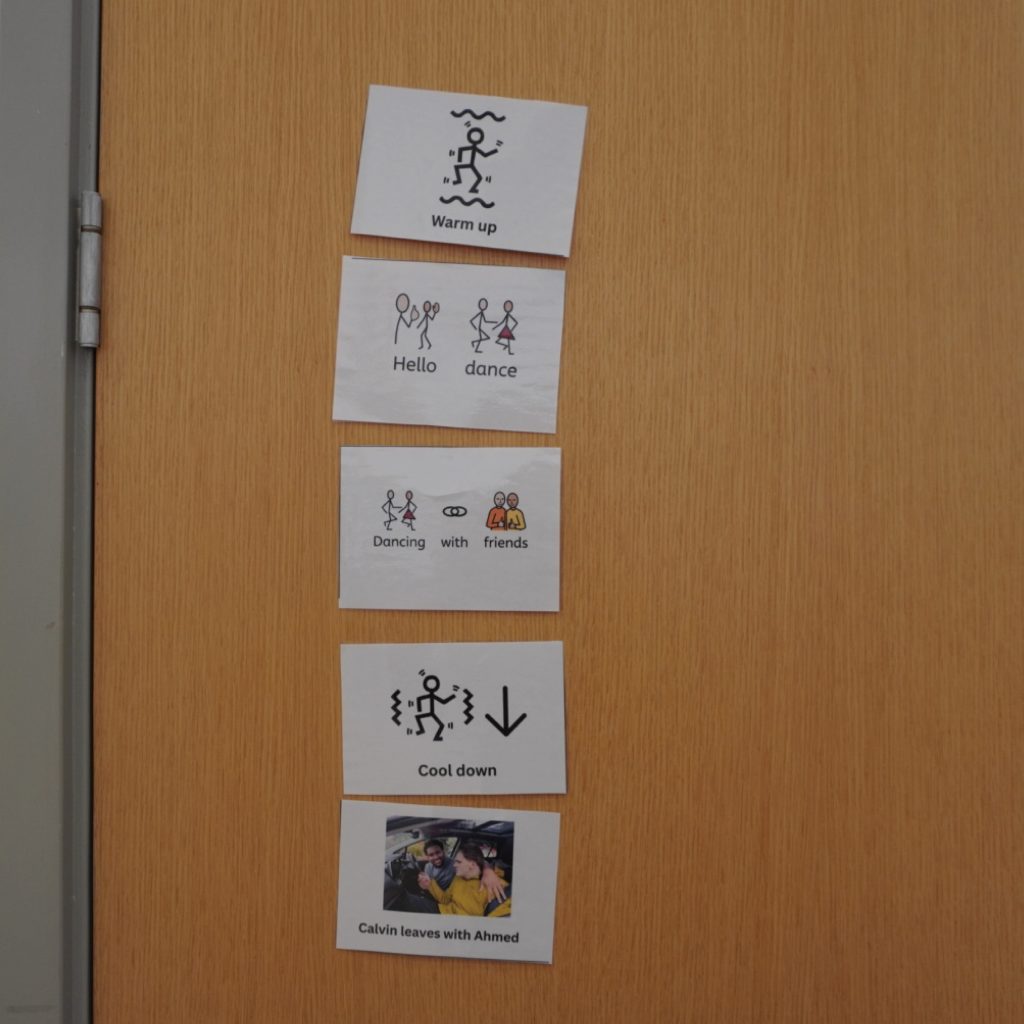
- Clear visual displays of rules and the day’s activities on the walls
- Schedules, advance information, and contracts prepared in accessible, easy-to-read formats
- Color markers on walls and floor cues to support orientation and movement in the space
- The natural use of non-verbal communication methods such as Makaton
- Shared check-ins and check-outs involving everyone in the space
- Clear awareness of the boundaries of the dance area
- A comfortable space, with rugs or cushions, where participants can rest
- Multiple ways for participants to communicate their condition or needs, beyond spoken language
- Systems such as an “I Need” board to express needs and states
- Sensory items are available that can help participants regulate their sensory experience or serve as creative prompts through touch, weight, sound, color, shape, and texture. These sensory items can support both comfort and artistic exploration.
These kinds of provisions are not viewed as special accommodations.
Rather, they are part of creating the conditions that enable everyone to feel comfortable in the space, engage with others, and participate in ways that are meaningful to them.
■ Returning to Practice: Questions for Your Own Context
In our own working environments, how consciously are we designing for the expression of need, the adjustment of communication, and the confirmation of boundaries?